
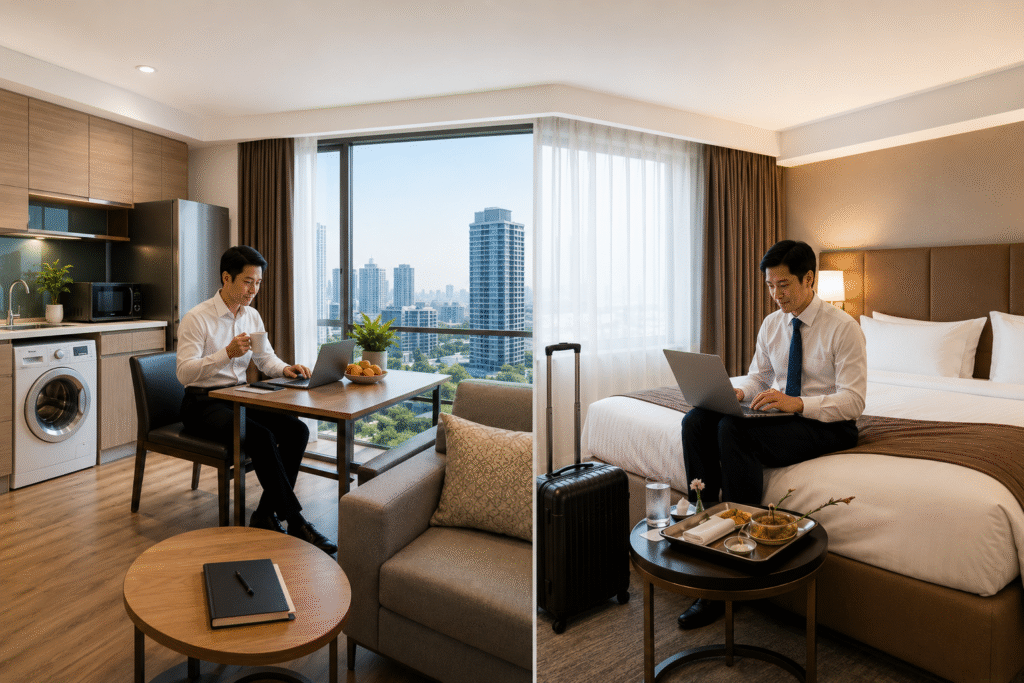
The Japanese professional arriving in Gurgaon or Pune or Chennai for a six-month assignment makes the accommodation decision once. Gets it wrong. Spends three weeks in a hotel room that was fine for the Mumbai layover and genuinely difficult for the extended project stay. Then finds a serviced apartment and spends the remaining five months living correctly.
This sequence is common enough to have become predictable. The serviced apartments vs hotel long stay conversation doesn’t happen early enough in the corporate relocation process, and the people who don’t have it early pay for it in the daily friction that the wrong accommodation format produces across weeks and months.
Why Hotels Begin to Fail After the Third Week
Hotels are designed for the transient guest. The person arriving Monday, leaving Friday, needing the breakfast included and the towels changed and the room service available at 10pm. The format is excellent for this. It is the wrong format for the professional whose assignment runs until March.
The absence of a kitchen is the primary variable that the serviced apartments vs hotel long stay comparison turns on, particularly for the Japanese business traveller whose dietary preferences, food preparation habits, and relationship with meal quality are specific enough that the Indian hotel’s multi-cuisine restaurant produces daily compromise rather than daily satisfaction.
Miso soup. Properly cooked rice. The specific food routine that the Japanese professional maintains as the anchor of daily life regardless of which country the assignment is in, the hotel kitchen cannot produce this and the hotel restaurant cannot substitute for it. The serviced apartment kitchen with the correct equipment can.
The second variable is space. A hotel room optimised for the overnight guest has the bed, the desk, the bathroom, the television. The professional whose Gurgaon assignment runs six months needs the space to separate work from rest, to video call without conducting the call from the bed, to maintain the physical and psychological distinction between the office and the residence that the hotel room collapses into a single room.
“For companies managing multiple long-term assignments annually, the accommodation decision affects not only cost, but also employee stability, productivity, and assignment satisfaction.”
Why Serviced Apartments Are the Best Stay for Japanese Business Travellers India
The best stay for Japanese business travellers India answer is consistent across the cities where the Japanese corporate community concentrates, Gurgaon, Chennai, Pune, Bangalore, Neemrana, the industrial corridors where the Japanese manufacturing and technology investments have established operations.
The serviced apartment format provides what the assignment actually requires rather than what the three-night business trip requires.
A fully equipped kitchen: The cooking infrastructure that the best stay for Japanese business travellers India specifically needs, the appliances, the utensils, the counter space, the ability to import the food routine from home rather than negotiating with the hotel restaurant daily about what can and cannot be prepared.
A separate living space and work space: The psychological separation between the office and the home that the Japanese professional’s approach to work-life management specifically requires and that the hotel room’s single-room format makes structurally impossible.
Privacy: A serviced apartment creates a resident relationship rather than a guest relationship. The distinction matters over a six-month assignment. One feels temporary. The other feels lived in. The distinction is felt daily rather than periodically.
Monthly pricing: The serviced apartments vs hotel long stay economics are not competitive for a three-night stay. They are significantly competitive for a three-month or six-month assignment. The monthly serviced apartment rate versus the nightly hotel rate multiplied by 90, the comparison produces a 40 to 60 percent saving that the corporate finance department notices and the travel desk should have noted at the booking stage.
“The accommodation choice is often made centrally by corporate travel teams. The consequences, however, are experienced daily by the employee living there.”
What Japanese Corporate Residents Actually Value
The best stay for Japanese business travellers India consideration extends beyond the physical infrastructure of the accommodation.
The Japanese professional community in India has specific requirements around reliability, cleanliness standards, communication clarity, and the predictability of service that the long stay requires to work. The hotel that is excellent at hospitality for the Indian domestic guest occasionally falls short on the specific calibrations that the Japanese long-stay guest requires, the maintenance that happens when requested rather than when convenient, the housekeeping that maintains the specific standard the resident established, the communication that is clear and complete rather than approximately accurate.
The serviced apartment operator who understands this, whose team has been managing Japanese corporate stays long enough to understand the requirements at the operational level rather than the theoretical one, produces the long stay that the assignment deserves.
“This is where the quality of the serviced apartment operator matters as much as the apartment itself.”
Long-Stay Living Designed Around Real Assignments
Six months in a hotel is a sentence. Six months at Enkay Condominiums is something closer to actually living in India.
Fully furnished apartments across studio, two-bedroom, three-bedroom, and four-bedroom configurations in Gurgaon, Delhi, Noida, Manesar, Neemrana, Mumbai, Hyderabad, Bangalore, and Pune, the cities where the Japanese business community’s India assignments concentrate. The kitchen that works: proper appliances, actual utensils, the cooking infrastructure that makes the food routine possible rather than aspirational.
The operational details are handled quietly in the background: daily housekeeping, round-the-clock security, and seamless check-ins that let the resident settle into routine quickly. Flexible lease terms that match the assignment duration rather than the calendar. A management team that the resident calls when something needs attention and that handles it.
The Enkay Group has been operating since 1960. For the long-stay business traveller, accommodation stops being a hospitality decision after the first week. It becomes a living decision. The companies that understand this early create better assignments for the people they send.
