
The corporate relocation conversation in India has a question that nobody asks loudly enough before the assignment begins. Hotel or serviced apartment? Most companies default to the hotel because the hotel is familiar, the booking process is standard, and the travel desk knows how to handle it. Then week three arrives. The hotel room that was fine for the first business trip is now the space where a suitcase has been living on the floor for twenty days, the restaurant breakfast has lost its novelty, and the professional who came to the city for a six-month assignment is negotiating with the hotel’s 7 am kitchen opening time for the fourth consecutive week.
Employee relocation accommodation is a distinct category from the corporate travel stay, and the companies that treat it as the same thing pay for that mistake in both productivity and cost. The professional who is relocated rather than travelling needs the kitchen, the living room, the space to establish the routine that makes a long assignment sustainable rather than endured. This guide covers the current market, where to stay, what to look for, and why the serviced apartment format consistently outperforms the hotel for the relocation brief.
Table of Contents
- The Relocation Brief Nobody Wants to Inherit
- The Hotel Model and Why It Breaks
- Corporate Housing Solutions That Actually Work
- Why the Employee Experience Is a Business Decision
- The Cost Argument That Finance Actually Listens To
- Enkay Condominiums: Corporate Housing Solutions for Relocation
The Relocation Brief Nobody Wants to Inherit
The email arrives on a Tuesday.
A senior engineer is relocating from Singapore to Bengaluru. Joining date, four weeks. Family of four. Spouse works remotely. Two school-age children. Accommodation required for at least six months while the family searches for a permanent home.
On paper, it sounds like an HR task. In reality, it’s much more personal.
The employee isn’t just changing offices. They’re changing cities, routines, schools, grocery stores, neighbourhoods, and almost everything that makes everyday life feel familiar. The children are leaving friends behind. The spouse is trying to recreate a working routine in a new country. The employee is starting a demanding new role while also helping the family settle in.
This is where the right employee relocation accommodation can make a bigger difference than companies sometimes realise.
Put the family in a hotel for a few nights and everything feels manageable. Put them there for six months, and the experience changes completely. The family starts missing home. The children get tired of eating restaurant food. The spouse struggles to find a quiet corner for remote work. The employee returns after a long day and finds that there is nowhere to properly switch off.
The accommodation may be temporary, but the stress it creates can become very real.
That’s why experienced HR and global mobility teams increasingly look towards corporate housing solutions that give relocating employees something closer to a home from the beginning.
The Hotel Model and Why It Breaks
Hotels are excellent at what they are designed to do, make short stays convenient.
Two nights? Easy.
A week? Still comfortable.
But at the three-week mark, the cracks often begin to show.
Consider a family of four living in two connecting hotel rooms. The children are trying to complete their homework while one parent is attending a video call. The other parent is working remotely from the bed because the desk is occupied. Dinner means deciding which restaurant to order from yet again.
Nobody is doing anything wrong. The accommodation simply wasn’t designed for this kind of life.
Then comes the issue of routine.
A family that is used to cooking breakfast together, packing school lunches, and having dinner at home suddenly has to plan every meal around a hotel restaurant or delivery service. After a few weeks, the convenience begins to feel tiring. Even small decisions, what to eat, where to sit, when to do laundry, start taking up mental space.
For the employee, the fatigue can be even more subtle.
They may be starting a new position, learning new systems, meeting a new team, and navigating an unfamiliar city. At the end of the day, they want to return to somewhere that feels settled. Instead, they return to a room that reminds them that their actual home is still somewhere else.
That feeling of being in-between can create loneliness and emotional fatigue.
The problem isn’t that hotels are uncomfortable. The problem is that comfort designed for a few nights doesn’t necessarily translate into comfort for several months.
Effective employee relocation accommodation needs to support everyday life, not simply provide somewhere to sleep.
Corporate Housing Solutions That Actually Work
The most practical corporate housing solutions tend to have one thing in common: they allow employees to establish a routine quickly.
Instead of constantly adapting to temporary accommodation, the employee can begin living normally while the relocation process continues in the background.
Separate Spaces for Separate Parts of Life
A two-bedroom apartment changes the experience for a relocating family immediately.
The children have their own room. The parents have theirs. There’s a living room where everyone can spend time together without having to sit on a bed.
That separation matters.
A parent can take a late work call without waking the children. The children can watch television while another family member works. At the end of the day, the employee can close the laptop and leave the workspace behind.
It creates a sense of work-life balance that is difficult to achieve when everyone is sharing a hotel room.
A Kitchen That Makes a Place Feel Like Home
The kitchen is often the feature that makes the biggest emotional difference.
After weeks of eating out, imagine the simple comfort of waking up on a Sunday and making breakfast together. Or preparing the food your children actually enjoy. Or cooking a familiar meal when you’re missing home.
These moments may seem ordinary, but during relocation, ordinary is exactly what people often miss.
A proper kitchen allows families to maintain dietary preferences, cooking habits, and familiar routines without planning their entire day around restaurant timings.
Flexible Terms for Moving Timelines
Relocations rarely follow the original plan perfectly.
A six-month assignment can become nine months. A search for permanent housing can take longer than expected. A project can be extended.
Good corporate housing solutions need to accommodate those changes without forcing employees to start the accommodation search all over again.
Flexible monthly, quarterly, and longer-term arrangements allow the housing to adapt as the relocation evolves.
Professional Management
A relocating employee shouldn’t have to become a property manager at the same time.
Housekeeping, maintenance, security, and day-to-day support should be handled professionally. If the water heater stops working or the Wi-Fi needs attention, the issue should be resolved without becoming another item on an already long list.
The goal of good employee relocation accommodation is simple, the employee should be able to focus on their new role and their family, not on managing where they live.
Why the Employee Experience Is a Business Decision
Companies sometimes view relocation accommodation primarily through the lens of cost.
But anyone who has relocated internationally knows that the employee experience can influence whether the entire move succeeds.
Imagine an employee who has moved across countries and is struggling to settle. Their family is still adjusting. The children are missing their old school. The spouse hasn’t yet established a social or professional routine. The employee is working long hours and returning to temporary accommodation that doesn’t feel like home.
Even a highly capable professional can experience fatigue under those circumstances.
Loneliness can creep in. Missing home becomes more noticeable. Small inconveniences become frustrating. The person may technically be settled in the city, but mentally they are still waiting for life to begin.
Now change the accommodation.
The family has separate rooms. They cook meals together. The children have space for homework. The spouse has a quiet place to work. The employee can finish the day, close the laptop, and sit down for dinner with the family.
The relocation hasn’t changed on paper.
But the experience has changed completely.
That’s why employee relocation accommodation is ultimately a business decision. People perform better when their lives outside work feel stable. Mental comfort creates room for focus, and a healthy routine makes it easier to adapt to a demanding new environment.
Companies that invest in thoughtful corporate housing solutions are not simply providing better accommodation. They are helping employees settle faster, maintain work-life balance, and transition into their new roles with fewer unnecessary distractions.
The Cost Argument That Finance Actually Listens To
There is also a straightforward financial argument.
Consider a family of four staying in a hotel for several months. The accommodation cost is only the beginning. Add restaurant meals, room service, hotel laundry, occasional meeting room requirements, and other incidental expenses, and the total can rise quickly.
Now compare that with a corporate apartment.
One monthly accommodation cost provides a furnished living environment with separate rooms, a kitchen, workspace, and access to professional services. Families can prepare their own meals, manage laundry more conveniently, and work from the apartment without hiring additional spaces.
The difference becomes more significant over a six-month relocation.
For companies managing multiple international transfers, the savings can multiply further. Instead of arranging individual hotel bookings every time an employee arrives, organisations can establish reliable corporate housing solutions with consistent standards and flexible availability.
The financial benefit is important.
But the bigger advantage is predictability.
HR teams know where employees will stay. Employees know what to expect when they arrive. Finance teams have clearer accommodation costs. Global mobility teams spend less time solving the same housing problem repeatedly.
Enkay Condominiums: Corporate Housing Solutions for Relocation
For a company managing employee relocation, the ideal accommodation needs to work for different people and different situations.
A solo executive arriving for a project needs a comfortable, move-in-ready space. A family of four needs multiple bedrooms and room to establish a routine. A relocated employee may need accommodation for a few months, while another may require a longer arrangement while permanent housing is finalised.
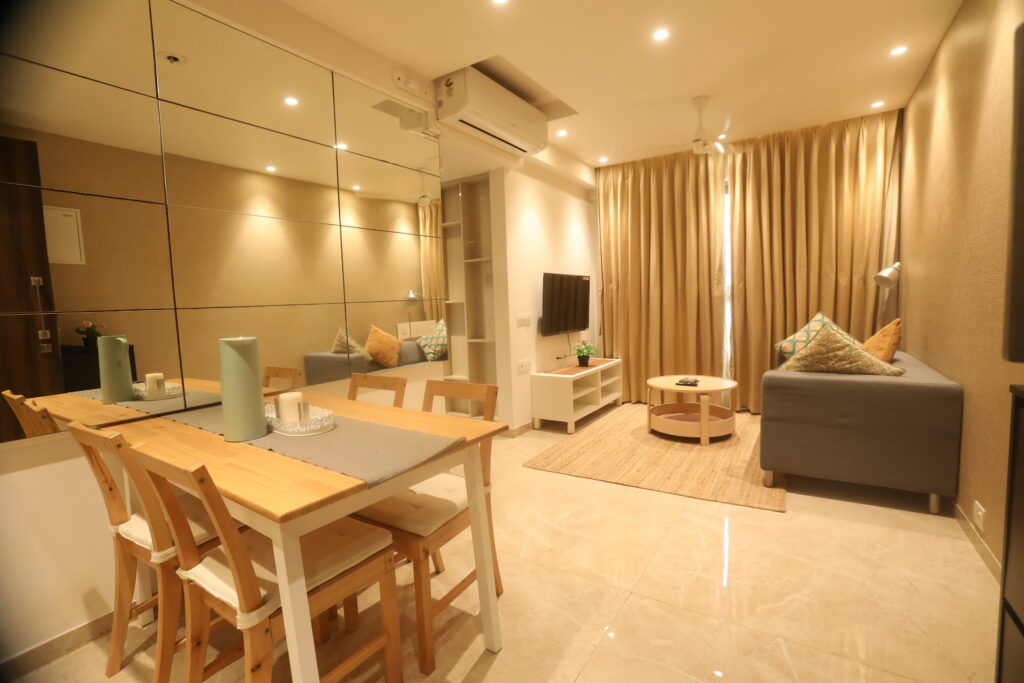
Enkay Condominiums offers fully furnished apartments designed around these different relocation needs, with studio, two-, three-, and four-bedroom configurations.
The practical details matter, move-in-ready spaces, equipped kitchens, daily housekeeping, high-speed Wi-Fi, 24-hour security and maintenance support, contactless check-in, and flexible leasing options.
But the real value of employee relocation accommodation is what happens beyond the amenities.
It’s the employee who can finally cook a familiar meal after a long day.
It’s the family that can sit together for dinner instead of eating in separate hotel rooms.
It’s the child who has a proper place to finish homework.
It’s the professional who can close their laptop at the end of the day and actually feel that work is over.
And perhaps most importantly, it’s the relocated employee who gradually stops feeling like a visitor.
That is what effective corporate housing solutions should achieve, not simply providing a place to stay, but creating enough stability for people to build a temporary life while their permanent one takes shape.
